
Value-Based Delivery17
Modernizing Business Analysis with AI & Experiments
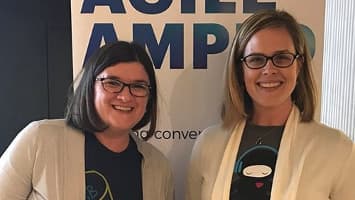


Angela Wick, Leslie Morse
February 25, 2019
Angela Wick, Leslie Morse
February 25, 2019
Angela Wick is the founder of BA-Squared and in this episode she talks about how business analysis is shifting drastically and how leaders are championing the charge. Wick discusses how important it is for business analysts to collaborate with Product Owners to focus on building the right products: "Agile can't happen without analysis... If you're building the wrong thing, it doesn't matter how fast you are."
But what is really exciting to Wick is how much the world and her field is changing as a result of AI and machine learning. What might take a BA weeks to produce, an algorithms today can do at a fraction of the cost and time. But the complexity in the world means that you have to pair vision with rapid experiments - and a dash of curiosity - to make sure your business is on the right path.
This episode of Agile Amped is part of a series in partnership with the Business Agility Institute. Podcast library: www.agileamped.com
Recorded live at the Business Agility Conference 2018, New York City
Leslie: Welcome to another edition of Agile Amped. I'm your host, Leslie Morse, and we are podcasting live here at the Business Agility Conference 2018 in New York City. Today my guest is Angela Wick. She is the founder of BA-Squared and is a passionate consultant and coach around modernizing how business analysis shows up in today's organizations. Angela, thanks so much for joining me.
Angela: Thanks, Leslie. Thanks for having me.
Leslie: Glad you're here. It's probably, gosh, been seven or eight years since we've sort of been interacting and working, back when I was doing business analysis stuff as well.
Angela: I know, it's so cool.
Leslie: And here we are at a business agility conference. Who would have thought?
Angela: I know, just another way to say BA.
Leslie: What was it that really drew you here this year?
Angela: Oh gosh, I came last year and I really loved all the conversations, the stories, the content, and just connecting it to the work I do.
Leslie: Are you seeing the practice of business analysis in organizations really shift now that ideas like business agility are gaining more popularity and more speed, more steam?
Angela: Great question. You know, they're definitely shifting, and leaders want them to shift. Some of the progress is slower in a lot of organizations, but I definitely see the passion from leaders wanting these practices to shift and bring agility. To be part of that agility process.
Leslie: I remember one of my big passion topics when I first got into agile was that there still is a home and a place for business analysis in organizations that are undergoing agile transformations and things like that. Is that still kind of a pervasive thing in the companies you're working with?
Angela: Absolutely. Absolutely. I mean, agile can't happen without analysis. What you call it, what the title may be, can change in organizations; business analysis is still a popular title. But you know, as organizations are maturing with their agility, they're realizing the importance of analysis too. That if you're building the wrong thing, it doesn't matter how fast you are, right? So it's all about: how do we make sure we're building the right thing, and building those right relationships, the trust in the organization, facilitating the discovery of what to build? And so that still comes to the forefront. It's still super important.
Leslie: Yeah. And so I think building the right thing is probably the most important aspect when we think about delivering rapid value for organizations. So what are some of the techniques that you're helping organizations undertake as they work on that idea of modernizing business analysis? What are some of those things that can help us build the right thing?
Angela: Gosh, I would say the biggest one I see organizations really struggling with is the idea of slicing their backlog items or, for some people, user stories, right?
Leslie: Yeah.
Angela: — into small, feedback-able increments, small pieces that are independent enough for us to rapidly deploy and get feedback on, to know if it's valuable and if it's the right thing. So the faster we can get a piece out and know we're doing the right thing, the more agility we can have. And that's a really, really tough piece for teams to create, right? So business agility and business analysis is like: how do we bring together the analysis to chunk it out into independent pieces we can get those feedback loops on? And that seems to be the most important piece that folks are missing. Are you seeing something similar?
Leslie: Yeah, I think it's still a classic conversation that we're having. I know in the practical work I've done with clients, it's really starting with what that big idea is. A lot of it is just functional decomposition, which is a very classic sort of business analysis technique. Is that still one of the go-to's for folks to use, or are there any new techniques that they're starting to employ?
Angela: Well, there are a couple of twists on it, right? So I think that's the basic skill, the decomposition. But really, the things we're looking at are user-story seeding, user-story splitting, but also really embracing the idea of simple-to-complex in our features, functions and products, and minimum viable, and not just minimum viable product, but how about minimum viable feature, and just minimum viable thinking overall, right?
Leslie: Yeah.
Angela: So, minimum viable thinking. That's what I call it.
Leslie: Yeah. I wonder, if we had a lot more space in our brains, [we could] figure out how to accomplish that.
Angela: We'd love it, right?
Leslie: Yeah, I mean, really just thinking about what's the simplest way I could build this feature, product or function, whatever it is you're building, and get some feedback on it to know if I'm on the right track. And that older mentality of "I've got to spec it all out and build everything" just needs to go away. But teams are really struggling to chunk it out and find what's that high-risk piece that we have to get feedback on to know if we're on the right track. So yeah, that's the analysis that has to happen, that we need our BAs and product owners to work together on.
Leslie: Yeah, on that topic. One of my favorite questions to ask product owners was, "What is the first thing that we need to prove that works?"
Angela: Love that question. That's great.
Leslie: Yeah, it really is. It makes you take that kind of risk-adjusted lens on the work that you're doing.
Angela: Totally.
Leslie: And it also forces you to think about everything in the backlog, not just little pieces and parts, because there actually might be a collection of backlog items that need to go through that. We need to prove they all work together, because if they just work in isolation but the set of them together doesn't work, then that's where we could really start running into problems.
Angela: Right. And that's the analysis of the backlog, figuring out which items… now, sometimes we call it dependencies. But I want to think about dependencies in terms of business value and customer value, instead of dependencies to develop.
Leslie: Yeah, that tends to be dependency, or technical ones.
Angela: Yeah. So with business analysis we're thinking about: what are the dependencies to get value? Which items do I link together, and in what order, to minimize risk, get feedback quick, adapt with change and innovation as it comes, and get to value? And you're right, there are 200 things in our backlog. Well, which two or three do I need to do next, based on what I just learned, to get the value I want and the feedback I want? And yeah, there are value dependencies, right?
Leslie: Yeah, there absolutely is. And there's also that idea. I always would talk to teams about the horizons in the backlog. There's that immediate horizon; what we've committed to now, what's in the next three or four sprints, and then what's kind of beyond this next planning horizon, like further out than maybe four or five sprints. Because if you're only ever worried about just this next set of work that we're going to take up, you could make some bad decisions that are going to make that next piece of it just a little bit harder than it really should be. So it's like you've always got to be looking just far enough ahead to make those right decisions.
Angela: Yeah, because we don't have business agility if we have rework because we couldn't see far enough into the vision.
Leslie: Yeah, but it's so hard to get what's just far enough ahead without the whole "we have to plan it and figure it all out up front."
Angela: Yeah, but isn't that really the focus on outcomes over outputs?
Leslie: It's a really good point, right? Like, if we know our vision, it doesn't mean we know every detail about the platform and the technology, but we know what outcomes we're looking for and a general path to get there. And that way our architects can save a lot of tech rework and we can actually plan technically. And sometimes rework is okay if we learn from it.
Angela: Yeah.
Leslie: And it changes our course for the better.
Angela: Yeah. And the thing that's important to talk about. There's a difference between rework, where we made bad decisions and really need to go rework stuff, versus refactoring
Leslie: Which we expect to do all of the time.
Angela: Because we should continuously be refactoring to make our products more elegant and stable and all of those kinds of things. I think it's really easy for people to get those concepts kind of twisted up in their head a little bit.
Leslie: Right, right. "Am I learning, or am I reworking?"
Angela: Yes, exactly.
Leslie: "Is the result of this needed because of what?"
Angela: Yeah, a little bit of root cause analysis there.
Leslie: Yeah. Another great day, exactly.
Angela: Exactly. So, right, business analysis is happening across the entire agile team, right? It's not just people who have a title of business analyst.
Leslie: But we think that BA–product-owner relationship is one of the most important ones within the agile team. What are some of the things that you've done to make that a really strong partnership?
Angela: Sure. I think it's really sitting down and helping both a BA and a product owner first make sure they have an understanding of the role that they have together. What's my mission as a team? Think about it as a tag team, kind of, right? And then how are we going to leverage our talents, strengths and skills together to make that happen? Now, there are some general places to start. In terms of a BA being kind of internally focused to the team, working on the details and carrying out that vision with the team, and the product owner being more externally focused, with the business units and leadership teams and markets and external customers. But you know, those two are a tag team together. And that's working in a lot of organizations really, really well. The difference of when folks start adapting that really has to do with the practices and skill sets in play. Some product owners just don't want to do anything detailed, and some BAs do really great big-picture thinking. So it's really teaming up, just like PMs and project managers and BAs in the past would team up and figure out where our strengths lie together as a team. I feel like that's kind of the product-owner/BA thing now, right?
Leslie: Yeah. I'd like to think of it as: if we build teams with the fewest number of people with all the right skill sets, then it's really about what are the skill sets that we're bringing to the table, because we've got to have all of them there in order to make this happen. So to me, another piece of this, especially when we start getting into building the right things, is user experience. Have you done much sort of overlap in how business analysis and user experience and product ownership, that kind of Venn diagram, play together?
Angela: Yeah, I've done some work in that. It's definitely different how every company and organization has that function spelled out, right? User experience can be on each team, or a shared team, with agile organizations it varies. But it's definitely a huge part of it, right? And I also like to talk about customer experience, to differentiate. When I say user experience, maybe when you say it too, sometimes I have to ask, like, well, are we talking about the classic screen-design pieces of [the deliverable], or can we think about it more holistically? Like, what truly is the emotional and functional experience I have overall as a customer and user?
Leslie: Yeah, that kind of end-to-end actual customer journey.
Angela: Right.
Leslie: And so I see myself using those terms interchangeably. I don't know about you, but I think it's really important to clarify that, and then figure out, okay, where is the BA role in that? Because I don't want to provide a misunderstanding that the BA role is all about designing screens.
Angela: Yep.
Leslie: Right? Because it's really so much bigger than that.
Angela: Yeah, it's definitely a lot more than that. And the product owner too, I think it's a collaboration like anything else. We've got to work together and use our talents together and then get it done.
Leslie: Yes, absolutely. I mean, we wouldn't be here if we weren't getting it done.
Angela: That's so true.
Leslie: Yeah. So what's sort of the newest thing on the horizon that you've been thinking about as it pertains to modernizing business analysis?
Angela: Definitely the intelligent automation, artificial intelligence, machine learning landscape.
Leslie: What got you into that?
Angela: Hearing all my clients talk about it.
Leslie: Okay.
Angela: Like, it's all of a sudden become a major topic where backlogs and priorities are shifting. Everything's happening on that front, right? And I'm sitting here going, "Whoa, are our BAs ready for this?" And I don't know. And I want to help with that and really dig into it. So I've been doing a ton of research on this, thinking about it and talking about it with folks, and formulating: how does this really impact our practices? And it's funny how agile it all is, right?
Leslie: Yeah. Are you thinking there's going to be, or, I guess, is the impetus for this excitement in your customers' needs, how they're leveraging AI and machine learning internal to their organizations, or how they're wanting to invest in that technology as they deploy value to their customers?
Angela: It's more about it being on the strategic agenda for the C-level.
Leslie: Gotcha.
Angela: And what I'm finding is that a lot of the team-level work, especially if they're not on an AI project or a machine learning project, I just scratch my head. Why am I meeting an AI project, a machine learning project? Shouldn't we be talking value streams and stuff, right? And customer journeys.
Leslie: Yeah.
Angela: But the people who aren't involved in those projects don't understand what it is, what it can do. They don't understand that the backlog they're working can be totally transformed with these technologies. And they're hearing about it in organizations, but they think it's just some other type of technology. They're not really understanding how this transforms the business and the business process and the customer journeys and experiences. So I think one of the biggest hurdles we have to get over, and I'm doing some stuff in my work on this right now, is: how do we teach, in plain English, what these things do and what type of features can be transformed? And honestly, it's about pairing it together. So machine learning paired with any number of artificial intelligence capabilities is what brings the value. So then BAs and product owners have to be able to analyze a customer journey and say, "Hmm, I've got to go from point A to point Z, 20-some steps right now, how can I get it into three steps? And wait, which AI capabilities can do it?" So we're going to need a lot more analysis along this path, and knowledge of what these technologies bring, not technically, but what do they actually bring? And then I think about, well, we can't automate everything. So then the business analyst and product owner have to decide: what do we automate this way? What's going to bring the most value?
Leslie: Yeah. And the question that goes on: just because we could automate it, should we?
Angela: Right. Right.
Leslie: There have been plenty of those projects, right? We buy some platform, we bring it in, and "oh, this supply-chain management thing enables us to automate shipments that go out this way and that way." That doesn't mean that just because we could do it, it's the right thing to do for our business. And that's going to be a piece of analysis that really plays in here as well.
Angela: Totally. And then I think, huh, there's no way that just traditional user stories and requirements, stuff people write about, is going to work for this stuff. We've got to really think outside the box on how we do this discovery and do this work.
Leslie: Are you having any ideas on how AI and machine learning are going to impact the way, not just the types of analysis that teams are doing as it pertains to how organizations use this technology, but how this emerging technology will actually impact the way agile teams work?
Angela: Oh my gosh. That's an amazing question. Other than, I think we're going to see a resurgence of hypotheses and experiments, and we're going to have to start doing our work that way more and more, which is going to force more teams to be even more agile, if I could use that as an adjective in a sense, right? I haven't thought real far in terms of how the team processes run, that's where you're going with that. But yeah, I just think it's going to bring hypotheses and experiments into play a lot more. Because I can't necessarily write a user story with acceptance criteria for machine learning, right? I'm really trying to say, "If I do this, I think this is going to happen." That's more the thing I'm testing out, the business value, versus trying to build it. Yeah, I don't know if I make sense.
Leslie: No, it does. I mean, I'm sitting here thinking about, as this stuff becomes more and more prevalent, we as individual humans just don't have the exposure and interaction with it that we've had with the types of technology we've been developing in the past. We've been iterating a lot of the same foundational concepts, and this is just an entire paradigm shift, where we've got to gain all this new domain subject-matter expertise and [learn] what it even means to work with this sort of stuff, right? In the same way that we've got all these people learning about blockchain and stuff like that, it's just a whole new mental model for what work are we doing, right?
Angela: Right. So the mental model, to your point, has so much knowledge, and everything's moving faster than we can acquire that knowledge.
Leslie: That's another reason it comes back to experiments.
Angela: And by the time we acquire it, it's probably stale.
Leslie: Exactly.
Angela: Which is a hard part. Because what we're learning is that these technologies are super quick and inexpensive to implement. Algorithms are free for machine learning. I mean, this is crazy how quick this is moving. So in the time you could write a traditional spec document that BAs would traditionally [write], you can have deployed and trained a machine and gone on to other pieces of value and work. And so it's just mind-blowing.
Leslie: It really does enable us to dramatically reduce cycle time for getting the feedback, if we can just let go of a lot of those traditional ways of thinking.
Angela: Exactly.
Leslie: I think this really kind of brings us to just some human aspects of it, and how important adult development is in today's day and age and the work that we're doing, because that ability to continually learn and let go of those preconceived notions about how things have been done in the past, it's core to business agility and achieving transformation in general, and being a good leader. But it's going to become more and more mandatory for all knowledge workers in today's enterprises.
Angela: You know, you hit on something. I just walked out of a session at this conference, and I forget exactly who it was, but they had a slide that said "curiosity," right? And obviously we've talked about curiosity for a long time as an important skill for BAs. But that's what you just hit on, right? Continuous learning. We have to be curious and keep learning to make this work.
Leslie: We can't just sort of ride on our prior achievements. "Oh yeah, I've learned all this stuff, we've got it mastered, let's just keep coasting."
Angela: Yeah, the amount of learning we're going to have to do here over the next, I don't know, rest of our lives, it just keeps growing exponentially.
Leslie: Totally. It's so important. So if somebody wants to learn more about modernizing business analysis, what are some good resources you might want to point them to?
Angela: Gosh, that's a great question. I mean, there are all kinds of resources online; blogs, all kinds online. I'd say just keep reading; I keep reading. And social media has got tons of links as well. What are you seeing as well?
Leslie: I was going to say following you on Twitter, I think you're sharing a bunch of really great stuff.
Angela: I was trying not to do a ton of self-promotion.
Leslie: No, that's okay. At least it's about helping people learn. So you know, and you're still just following the #BizAgility hashtag, and even the great [BA] business analyst [accounts] on Twitter is still a good one that I think has got a lot of great resources and other things coming up.
Angela: Absolutely. Because I think all the different modern sources that are out there are coming out through the social media channels. Yeah, absolutely.
Leslie: Any final thoughts today before we wrap up?
Angela: No, thanks so much. This is so much fun, because I know we were tweeting at ourselves trying to get together and catch up, and yeah, we ended up at the end of the forum catching up with you.
Leslie: Exactly. Exactly. We were so funny. Yeah, thanks for being here. I'm excited to get to enjoy the rest of the conference and spend some time together.
Please subscribe and become a member to access the entire Business Agility Library without restriction.